Friday, 21 March 2014

How to avoid multiple personality brand disorder: a look at Virgin Trains

This blog post was originally published on Discoverage - The Precise Brand Insight Blog.

During last month’s stormy weather, Virgin Trains tweeted a message to its customers to “ABANDON ALL TRAVEL”. This didn’t just get the attention of its followers who re-tweeted and replied in considerable numbers, it also led to a huge variety of spoofs and comments filled with dry humour and feigned panic. Newspapers and media picked up on the Twitter trend, leading to prime-time interviews and mainstream media coverage. By posting an overly dramatic but tongue-in-cheek tweet, the reach and impact of Virgin Trains’ message was increased easily tenfold compared to more ordinary updates.

There is an important lesson here for businesses using social media channels for their communications. Many businesses have a strict separation between their marketing communications, corporate communications and customer relations; and they are often not quite sure how social media fits in to that mix.

Tuesday, 5 June 2012

Social Media: human or algorithmic analysis?

Social media analytics are usually based on numbers. Whatever comment or opinion occurs in the highest volumes is considered an important trend, while low-volume minority opinions are discarded. However, research shows that it takes a 'seed set' of less than 1% to cause the rest of the network to adopt a trend. Ignoring minority comments risks missing the chance of influencing community opinion. But should we rely on mathematical models or human analysis?

Thursday, 26 January 2012

Profile pic protests are invisible

Could identifying and reading text in profile pics become the next step in social media monitoring? I recently changed my Twitter profile pic to include a little banner that says: "Stop SOPA". Obviously any sane person would oppose a law that completely bypasses due process to allow whole businesses to be shut down as a direct result of one unverified complaint.

But then it struck me, I was not in fact making my voice heard at all. To be heard, protests must be measurable. That is why we have petitions and protest marches: so we can be counted. There are plenty of social media monitoring companies out there that gather information from the web in lots of different ways but all of them, as far as I'm aware, are essentially text-based. Social media monitoring tools can count how many times the word SOPA appears, but even though profile pics are often collected as well, the content of those pics themselves is not being picked up by automated search terms. The best social media companies, like the one I work for, combine automated data-harvesting with human analysis to pick up on details like that, but even we would have no way to give an exhaustive quantitative measure of how many pics contain banners or certain words, or a pictogram-style protest message.

Possible solutions for monitoring purposes could lie in the type of facial recognition software already used by Facebook. If such technology can recognize your friends' faces, surely it could use OCR to recognize and read text in a pic, or even identify a given motif. Another option would be to collect and collate the personal data from such services as Twibbon who change your profile pic for you. At present, neither of these avenues have yet been explored by any social media monitoring company I am aware of. This is a shame because a lot of shared content is becoming more and more visual.

For now, although a picture speaks a thousand words, those of us who really want to stand up and be counted, should use our 140 characters to the greatest effect.

Monday, 12 September 2011

Why you need a community manager

I'm looking for work in social media as a community manager with experience in analysis. Not all companies know why they need one of those, so I'll tell you. Remember the good old days of SEO? With cleverly chosen keywords and links, you could get your site on the top of the search results in Google, and on a PPC basis you could appear on the paid links as well. That doesn't work as well any more. Nor does plain old advertising.

Wednesday, 10 August 2011

Open Letter to Anonymous

Dear Anonymous,

I read on Mashable that you intend to attack Facebook in the name of protecting my privacy. I don't appreciate that at all. You claim you are fighting "a battle for choice and informed consent. Facebook keeps saying that it gives users choices, but that is completely false." If you succeed in taking down Facebook you are removing my choice to be a part of it. You cannot fight for freedoms by taking them away.

I am aware that Facebook monitors and sells my data and I don't mind that at all. You present the idea of them accessing and using my data to make money as if it

London Riots - My idea on how to deal with looters.

Anti-riot: Operation 
Cup of Tea
Everything seems to have quieted down now, although we've been hearing a lot of sirens in the background today. I live in a residential area not near any shops so have had no looting locally, although I've heard rumours of local high streets being hit.
I've seen the idea bandied about to hit looters and rioters with water cannons loaded with smart water or indelible dye, which I think is a lovely idea. That way, all those present can be easily identified later. There is no such thing as an 'innocent' bystander. The police very clearly asked people to stay in and stay away so they could get to work. Anybody still spectating would be actively hindering police and fire departments from doing their job.

But what to do with the looters once they're caught? Put them in jail? What's the

Saturday, 30 July 2011

Sharing and owning. Social media and gamification.

I read a lot about social media and gamification. Social media are a great platform for people to get and stay in touch with one another, for brands and people to connect, for information to travel freely. Gamification is a way to measure progress and motivate. Especially gamification is however often lambasted for being hollow and cynical. Rebranding real-world goals as game goals, and measuring real-world progress in points is seen by some as a reduction of true interaction.

I don't think it is a reduction. It's more like a restructuring that we need in order to be happy. Jane McGonigal pointed out in a TED-talk that people were already playing

Tuesday, 28 June 2011

Six to Start and BBC Team Up for “The Code Challenge”


Six to Start and the BBC have teamed up to create a transmedia experience tied in with BBC Two documentary The Code, expected to air at the end of July. The Code is presented by Professor of Mathematics Marcus du Sautoy (Horizon on BBC2, The Beauty of Diagrams on BBC4) and explores how the world around us conforms to and can be explained by mathematical codes. Six to Start are next-generation storytellers with plenty of experience creating storytelling projects for different clients, often in the form of alternate reality games or treasure hunts. They’ve worked with the BBC before on projects like Spooks: Code 9 and Seven Ages Quest. As a first for the BBC and possibly a world first, an interactive experience called The Code Challenge has been seamlessly integrated in the writing and filming of The Code since inception. Viewers can participate in an

Monday, 6 June 2011

Get real!

If you live in the real world, which one am I in?

Sometimes I get upset with typical things people say that simply make no sense. How often have you read or heard someone exclaim that they live 'in the real world', implying that whoever has incurred their pet hate for the day, does not? Parents tell teenagers about the real world; opposition politicians love to imply that the ruling politicians do not inhabit the real world; people of a certain class, income level, or job-type will readily claim that others aren't in the real world. My question then: if I'm not in the real world, then where am I? Even in multiverse theory, every possible world is real. Of course, the word 'real' is meant more metaphorically, as an indication of socio-economic circumstances. But my problem remains. What could possibly make a plumber's life more real than a banker's? An adult's more than a child's? An economist's more than a person on a low wage? We all observably and obviously inhabit the same reality.

A similar mistake that gets my goat is when people think that crimes are a state of mind. As much as some governments might like to, it's actually impossible both practically and legally to detect or punish thought crimes. Repeatedly I read in the paper (paraphrased): "I wasn't really speeding, I'm not a boy racer." "I said some things while drunk, but I'm not a racist." Tough luck. The law doesn't punish people for what they are, it deals with what people do. Driving too fast is against the law, no matter what your state of mind was while you did it. Directing certain terms at people is against the law; whether or not you are a racist can never be determined anyway.

That's how it works in the real world.

Tuesday, 31 May 2011

What's Twitter?

I flagged a few interesting things to blog about over the last few days, and I realised there were very different views and news on Twitter. What's Twitter?

It's a social media platform where anybody can leave little messages of 140 characters. You follow the tweets you want in your feed, and then there's hashtags, @mentions, and retweets.

You know all this. But what is Twitter?

Is Twitter a published medium (like a newspaper) or a public conversation (like you and me talking and being overheard at a bus stop)? Does it have, or is it a responsible publisher? Is it censored or free? Is it social media or a marketing tool? Can it also be a payment method?

Tuesday, 17 May 2011

Crowdsourcing moderation

I work as a moderator of user generated content and when I first spotted this link: http://www.contentmoderator.com/ in my twitterfeed, I had a short moment of panic. Was this automated moderating software? Would I be replaced by a robot? I shouldn't have worried, because the link was tweeted by @Crowdsourcing_ so it's all still all about people. Contentmoderator works via ScalableWorkforce, which in turn is a platform enhancing Amazon's Mechanical Turk. The service Contentmoderator provides to companies, brands, or anyone hosting content online, is that their content will be moderated against their own choice of guidelines by trusted moderators. The system seems to be that the

Monday, 16 May 2011

Gamification is the future, but not as we know it.

Dr Richard A. Bartle, Senior Lecturer and Visiting Professor of Computer Game Design at the University of Essex, UK is often quoted by, well pretty much anyone involved with gamification... And I'm just about to disagree with him. I just read Will Gamification be Ubiquitous in 5 Years? on Gametuned, and although I believe Dr. Bartle makes a few good points, he's missing some important new developments. Either that, or his and my definition of gamification just don't agree.

In the slides for his recent talk, Dr. Bartle seems to focus on the type of gamification that is often used by marketing departments to bribe people into behaviour they like to see (buying things or free advertising). This sort of gamification is not made by game designers and is driven mostly by extrinsic rewards. He explains quite correctly why this sort of gamification does not work in

Friday, 13 May 2011

Sock it to me

My vintage sock puppets.
Prepare to work your socks off at Socks Inc., the factory where we make believe. Socks Inc. is the largest employer of sock puppets in the world and if you play your cards right, you too could be hired, today! All you have to do is make your own sock puppet (you can find a tutorial here), go the website and get started. Socks Inc. will send you on countless storytelling missions that will keep you on your toes.

To begin, you log in to the website using either the Facebook login button, or an off-Facebook login for younger players, and enter the factory. This game is not played in real time, which means you can play whenever you like, for as long as you like, and even replay your favourite missions. The main storyline is explored in the boss’, Mr. Barnsworth’s, office, with other themes, stories and missions available in

Sunday, 8 May 2011

Don't extinct, excel!

I recently got into a discussion with some people on Facebook. A friend had posted a link about the impact of humans on the environment and some of his friends mentioned being supporters of the Voluntary Human Extinction Movement. I couldn't keep quiet even though I generally know better than to argue with extremists on the internet. To my mind, anyone who advocates human extinction is depressed and suicidal on a species-wide scale and needs some mental health care. Obviously, I do realise humans haven't been taking very good care of their environment, but to extinct us just isn't normal and natural behaviour. The VHEM has a lot of arguments for their case on their website, and a lot of them are fallacious or at best one-sided half-truths. My two main arguments in favour of the presence of the human race on this planet are featured as well.

Saturday, 30 April 2011

Cloud Girlfriend - less cloudy more real

Cloud Girlfriend has gone live. It didn't quite turn out to be the kind of game I had envisioned at first. Instead of interacting with a fully fictional character, the aim is now for both men and women to join and create fictional versions of themselves. These super-avatars will then have 'dates' with each other, and may eventually decide to meet each other in real life.

The initial pitch presented romance as an alternate reality game with a written or scripted non-player antagonist, played entirely online. The version that has now emerged takes cloud romance out of the virtual and connects it to real life. But it's not quite a dating service and it's still definitely not about tricking people. Unlike online dating sites

Thursday, 28 April 2011

Parenting Game

I've begun working on a parenting game recently. When I say 'working', I mean I came up with the idea and I've starting thinking about how it could be done. Some of this thinking I've done online and some of my friends on Gameful have already helped with some feedback and good ideas.

So here's my pitch:

One of the areas of life that could benefit from an added layer of gamification could be parenting. Parents often feel daunted, pressured, criticized, insecure, or indecisive, not to mention under-appreciated both by other adults and society, and by their own kids! Even though being a parent is one of the most intrinsically rewarding things one can do, it isn't always fun.

Saturday, 16 April 2011

Regeneration and rejuvenation: science fiction... right?

Having just watched Susan Lim and Anthony Atala talk on TEDMED, I'm amazed at what modern science can already do. They can take adult stem cells and turn them back into fully versatile stem cells - similar to embryonic stem cells but without the ethical dilemmas - and use them to regrow broken organs in the body. Another option is to take working cells from the bit of body you need to repair and grow more of them in a Petri dish. Then you take the cells, put them on a 'scaffold' and grow a whole new organ. There's actually someone out there who has a working bladder grown in a lab from her own bladder cells more than a decade ago.

I wonder if this would work for pituitary glands, and other glands in the body? The current research seems to focus on kidneys and livers because that's what the majority of people on the waiting lists for donor organs are waiting for. Are pituitaries more complex than kidneys and livers, or similar?

I imagined a cyborg solution to the problem of broken pituitaries, using nanotechnology. It seems the cell biology approach is the more likely candidate for success.

Wednesday, 13 April 2011

Discover History at NYPL and Find the Future


According to Jane McGonigal, gamers tend to read books more than they watch TV. Books give us big ideas and inform our imaginations, create new worlds and take us on amazing adventures. Oddly enough, the place where books are kept and made available, the library, does not usually fill us with the same sense of wonder. The New York Public Library wants to change that perception. The library’s goal is to “inspire people around the world to see libraries as a place where they can achieve their dreams and invent their own future” and “show off NYPL as a space for active creation and social collaboration.” To do this, the library has developed Find the Future, an interactive experience that guides visitors through the many artifacts housed at the New York Public Library. The game is directed by Jane McGonigal and her husband Kiyash Monsef, and designed and developed by Playmatics and Natron Baxter Applied Gaming.

Saturday, 9 April 2011

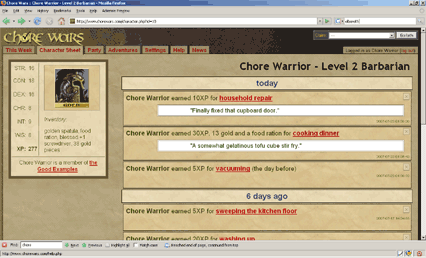
Alternate reality game Chore Wars

My family and I have recently started playing Chore Wars, an alternate reality game that allows you to gain experience points for doing household work. It's an incredibly versatile game as you can design your own quests, so you can in principle use it for anything. For example, I've set up an alternate account for playing Superbetter, with quests and points for such things as filling the monthly pill box or talking to a friend.

But back to its intended purpose. When you log in to Chorewars, you pick an avatar and fill in some questions by which the program decides what class you are and gives you initial stats for strength, constitution, dexterity, charisma, intelligence and wisdom. It then prompts you to set up a group and invite new members. You can play privately, or share your achievements with other players online, getting competitive between teams. But first, it's time to set up your adventures. You can use a pre-made list of adventures that are taken from the most popular ones on the site, or create your own. Each adventure is fully customizable.